
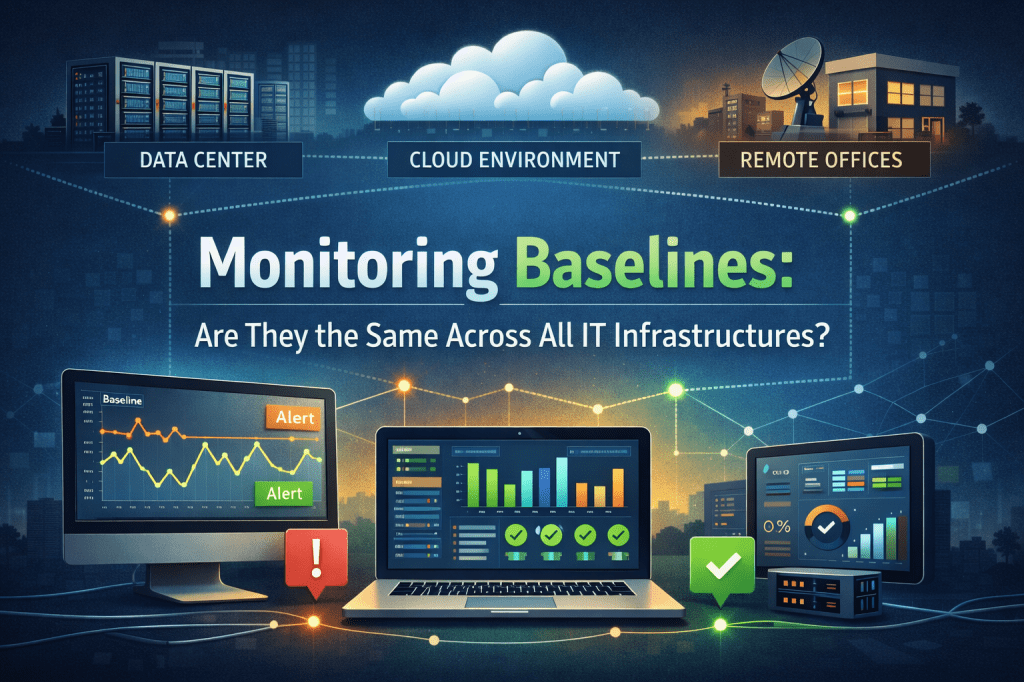
Monitoring baselines plays a crucial role in identifying and protecting critical components of an IT environment. However, applying a single, uniform baseline across all infrastructures is rarely the right approach.
While certain monitoring parameters may appear similar across environments, the real differentiation lies in alerting criteria. Only a limited set of alerts can be universally applied. Most alert thresholds and conditions must be tailored to the specific needs, risks, and priorities of each business.
Every organization operates with unique objectives and constraints. What is mission-critical in one environment may have minimal importance in another. Effective monitoring should reflect the real understanding of the environment, aligning technical insights with business context rather than enforcing a one baseline for all.
Step 1: Understand the Architecture
Begin with a comprehensive understanding of the overall IT architecture which will help in identifying potential points of failure operations flow:
- Network design and topology
- Core infrastructure components
- Interdependencies between systems and services
Step 2: Analyze the Components
Drill down into individual components to understand their roles and behaviors:
- Structure and distribution.
- Primary versus failover responsibilities
- Differences across development, testing, and production environments
Step 3: Define Priorities
Establish monitoring priorities based on business relevance:
- Business impact of failures or degradation
- Risk level and component criticality
- Effect on end-user experience for companies delivering services to consumers.
By aligning monitoring baselines with business priorities, organizations can help is setting targeted alerting that focus on what truly matters to support the team to respond more effectively when issues arise.
 Fingerprint in IT
Leave a comment