
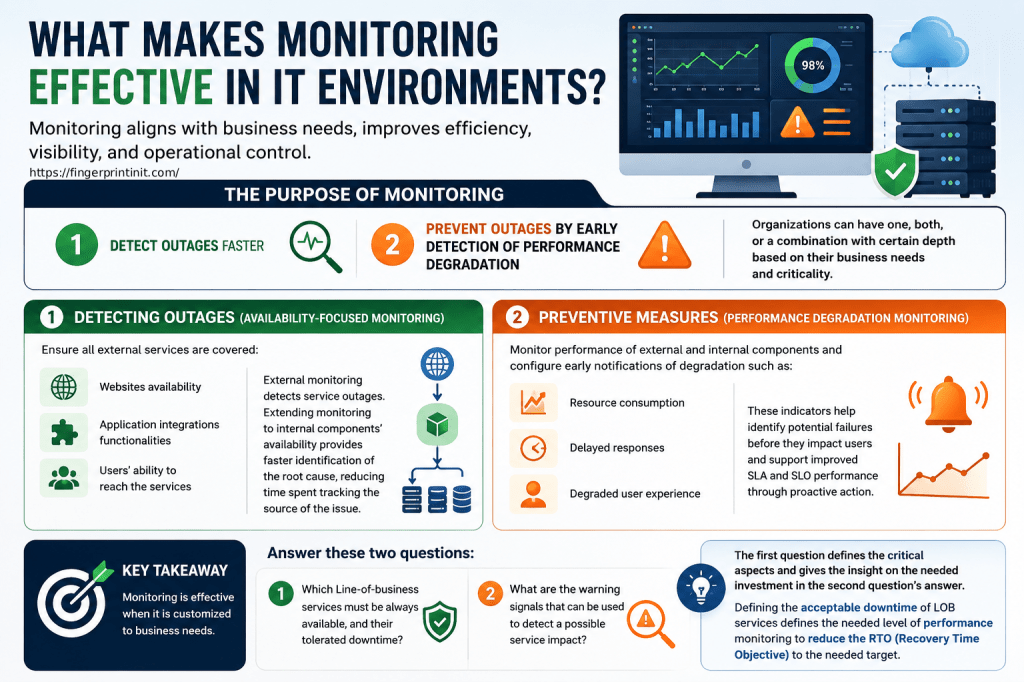
What makes the monitoring setup more effective to the IT environments? Monitoring always aligns with the business needs, acting as a supporting layer improving efficiency, visibility, and operational control.
How to improve the effectiveness of the monitoring tools?
To answer this, we first need to define the purpose of monitoring. It usually serves two core objectives:
- Detect outages faster
- Set preventive measures for outages by early detection of performance degradation.
Organizations can have one, both, or a combination with certain depth based on their business needs and criticality.
Detecting outages (availability-focused monitoring)
It ensures all the external services are being covered with needed monitoring. Those can be:
- Websites availability.
- Application integrations functionalities.
- Users’ ability to reach the services.
The external services availability is to detect service outages. However to improve recovery time, extending the monitoring to the internal components’ availability provides faster identification of the outages’ root cause, allowing the IT teams to reduce the time spent on tracking the source of the issue.
Preventive measures (performance degradation monitoring)
It extends the monitoring to cover the performance of the external and internal components and configuring early notifications of the performance degradation, such as:
- Resource consumption
- Delayed responses
- Degraded user experience.
These indicators help identify potential failures before they impact users and support improved SLA and SLO performance through proactive action.
What makes the monitoring effectively customized to the business needs is the answer of these two questions:
- Which Line-of-business services must be always available, and their tolerated downtime?
- What are the warning signals that can be used to detect a possible service impact?
The first question define the critical aspects and gives the insight on the needed investment in the second questions’ answer. Defining the acceptable downtime of the LOB services determines the needed depth of performance monitoring needed to meet the target RTO (Recovery Time Objective).
 Fingerprint in IT
Leave a comment